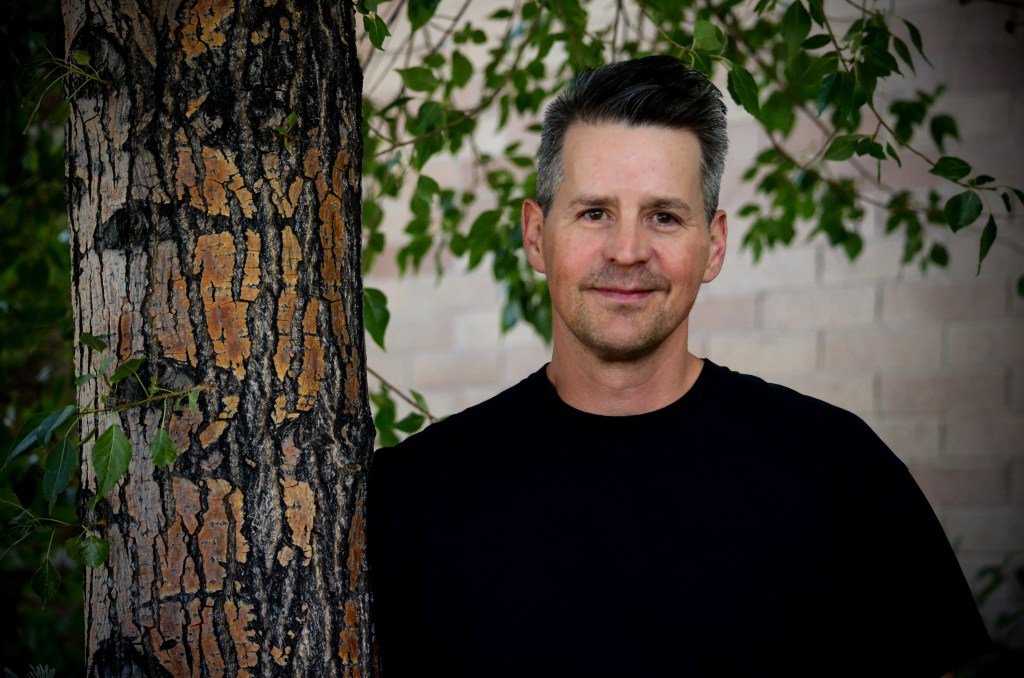
Caskey Russell is from Seattle Washington, and has lived in Washington State (Bellingham, Seattle, Kirkland) Oregon, Iowa, Wyoming, and New Zealand. He is a father, a professor, a musician, and an enrolled member of the Tlingit Nation (Eagle / Kooyu Kwáan) of Alaska.


The Author’s Grandmother’s Gravestone on Peratrovich Island, Alaska
Like all living things, stories are fragile
My grandmother Teew was born and raised in Heenya Kwáan (Klawock, Alaska), but her origins come from the Kóon Hít (Flicker House) of the Naasteidi Kooyu Kwáan on the eagle/wolf side of the Tlingit Nation—the Alaskan Native tribe knowledgeable readers will recognize as the basis for the Aaní in The Door on the Sea. Teew is the daughter of Kwaatk’wa (Josephine Peratrovich Smith), who’s the daughter of Mary Skan, who’s the daughter of Kaat’eich (Catherine “Kitty” Snook Skan Collins). As a young woman, Kaat’eich survived the scourge of smallpox that nearly destroyed Lingít Aaní, or southeast Alaska, in the 1860s.
Kaat’eich’s entire village, Kooyu Kwáan, on what is now Tebenkof Bay on Kuiu Island, all perished except for 14 or 15 people, mostly children. The longhouses of Kooyu Kwáan, including the Flicker House, were torched in a futile attempt to prevent the spread of the disease. As her family and relatives lay dying, Kaat’eich escaped in a canoe with her brother and a handful of other survivors. It’s difficult for me to imagine looking at your home for the last time, but Kaat’eich must have watched Kooyu Kwáan and its smoldering longhouses disappear as she paddled away.
The survivors canoed long miles to the village of Klawock on present day Prince of Wales Island, but the Klawock Tlingits refused them entry—they wanted no smallpox refugees sickening their village. So, Kaat’eich and her young crew paddled to a river not far from Klawock where they camped for weeks. I don’t know how they survived.
Eventually, the Klawock Tlingits took them in. Kaat’eich lived the rest of her life in Klawock, a very long life indeed: she walked into the forest, as Tlingits say, in 1941 near the age of 105. She never returned to Kuiu Island, though she told her story to her daughters, granddaughters, and great-granddaughters. My family’s knowledge of our history begins with Kaat’eich. We know of nothing before her. Smallpox erased the stories of Flicker House. I wish I knew those stories.
Stories are fragile. Part of the reason I wrote the novel was to inspire new stories about the Flicker House and to encourage young Tlingits to create new stories grounded in Tlingit worldviews and protocols.
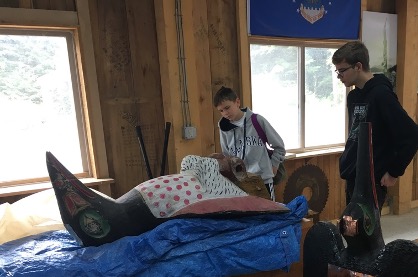
The Author’s Boys (Caraiden and Chetdyl in the Books) in Klawock, AK
I wrote most of this novel during the Covid-19 pandemic. Just before the pandemic, in the summer of 2019, I returned to my grandmother’s village of Klawock, Alaska for the first time in many years to visit my her gravesite on Peratrovich Island – a small island near Klawock. Juneau is easy to get to. So is Ketchikan. Klawock needs some planning. I brought my family with me. My boys had never been to Alaska. We rolled into Klawock on a rainy July night, but the next morning it was sunny. The bears weren’t out, but we knew they were in the forest close by. I took my family to the workshop of Klawock’s master carver. I hadn’t seen the carver in twenty years, and I doubted he would remember me, but he had designed and painted my grandmother’s burial box years earlier. After reintroducing myself, a smile played across the carver’s face and a light rose in his eyes.
“Now, I understand why this guy took flight.”
He pointed to a large, carved, wooden flicker that had, until two days earlier, sat atop one of the largest totem poles in Klawock’s totem park. After decades standing sentry high above Klawock, the flicker had toppled from the pole onto the lawn below. The carver hauled it back to his workshop for repairs. The pole recounts the destruction of Kaat’eich’s village, Kooyu Kwáan, by disease. It belongs to our house and clan. Up close, we could see the flicker’s beautifully carved body painted white, black, and blue and covered with red dots. Smallpox.
“He knew you and your family were coming and he wanted to talk to you.”
