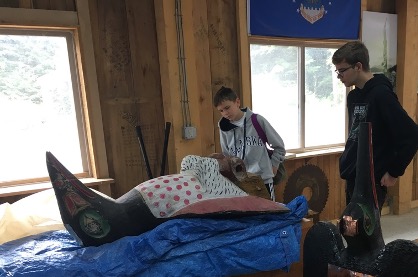
I wrote most of this novel during the Covid-19 pandemic. Just before the pandemic, in the summer of 2019, I returned to my grandmother’s village of Klawock, Alaska for the first time in many years to visit my her gravesite on Peratrovich Island – a small island near Klawock. Juneau is easy to get to. So is Ketchikan. Klawock needs some planning. I brought my family with me. My boys had never been to Alaska. We rolled into Klawock on a rainy July night, but the next morning it was sunny. The bears weren’t out, but we knew they were in the forest close by. I took my family to the workshop of Klawock’s master carver. I hadn’t seen the carver in twenty years, and I doubted he would remember me, but he had designed and painted my grandmother’s burial box years earlier. After reintroducing myself, a smile played across the carver’s face and a light rose in his eyes.
“Now, I understand why this guy took flight.”
He pointed to a large, carved, wooden flicker that had, until two days earlier, sat atop one of the largest totem poles in Klawock’s totem park. After decades standing sentry high above Klawock, the flicker had toppled from the pole onto the lawn below. The carver hauled it back to his workshop for repairs. The pole recounts the destruction of Kaat’eich’s village, Kooyu Kwáan, by disease. It belongs to our house and clan. Up close, we could see the flicker’s beautifully carved body painted white, black, and blue and covered with red dots. Smallpox.
“He knew you and your family were coming and he wanted to talk to you.”
